Token Taker
Duke University First-Year Design Program
Objective
Design a machine that enables the creation of a token economy within Kidzu Children’s Museum’s space-themed mobile museum. This “Token Taker” must collect tokens at each station, provide instant gratification to indicate activation of the station, have tactile elements, and match the museum's outer-space aesthetic.
Design Criteria
Outcome
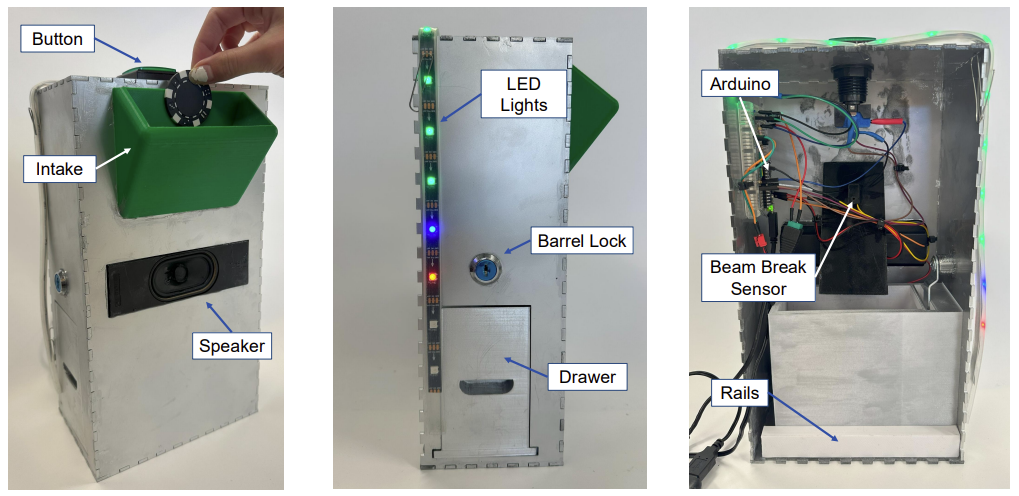
Our team built a Token Taker machine that blends in seamlessly with the museum’s metallic interior. The input of a token into the machine triggers a button to light up, which causes a visual and audio output when pressed. This provides museum visitors with instant gratification, signaling that they can use the station.
To begin the brainstorming process, our team identified a list of design constraints and criteria, each with a corresponding performance criteria.
Kid safe → No loose parts smaller than 1 cubic inch
Indicate the station is activated → Electronic output lasting 2-5 seconds
Durability → Lasts 6 months without maintenance
Token storage → Holds 40-50 tokens
Match aesthetic of truck → >70% of surveyed individuals agree
Accessible for 5th graders → Mounted at 4-4.5 feet high
Temperature resistant → Withstands 100°F
Reproducibility → <$250 per unit
Ideation & Solution Selection
To ensure our Token Taker effectively met Kidzu’s needs, we conducted a multi-stage ideation process that began with research and extensive conservations with our client. We then broke the Token Taker down into 6 separate design blocks, “brain-dumped” ideas onto notecards for each design block, and then created screening and scoring matrices to identify the optimal solution.
Ultimately, we decided to create a Token Taker machine with the following features:
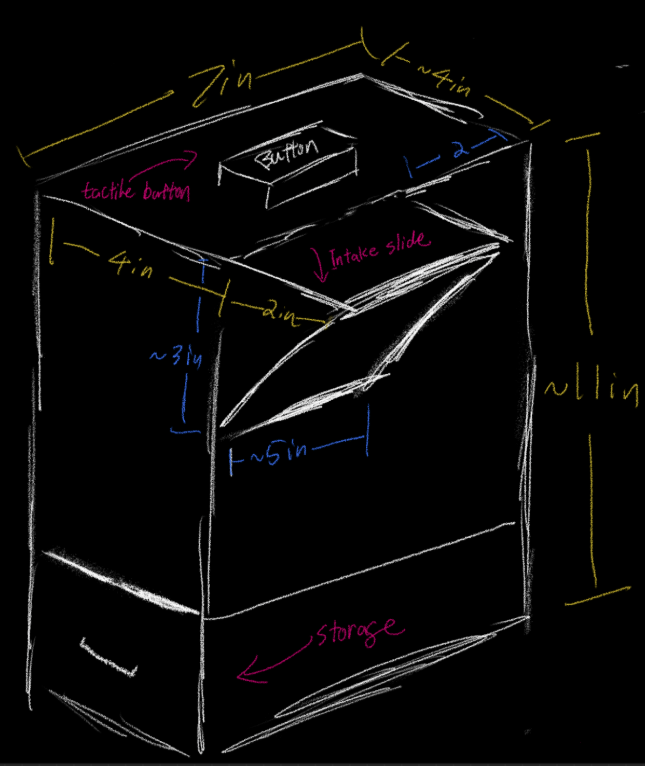
A flat slide/funnel with an opening just big enough for the tokens to slide in
An optical/beam-break sensor to detect the token and activate LED lights behind a button
When the user presses the button, it triggers LED lights around the machine and a speaker
A drawer with a hidden latch/key opening mechanism to store and remove the tokens
Prototype Evolution
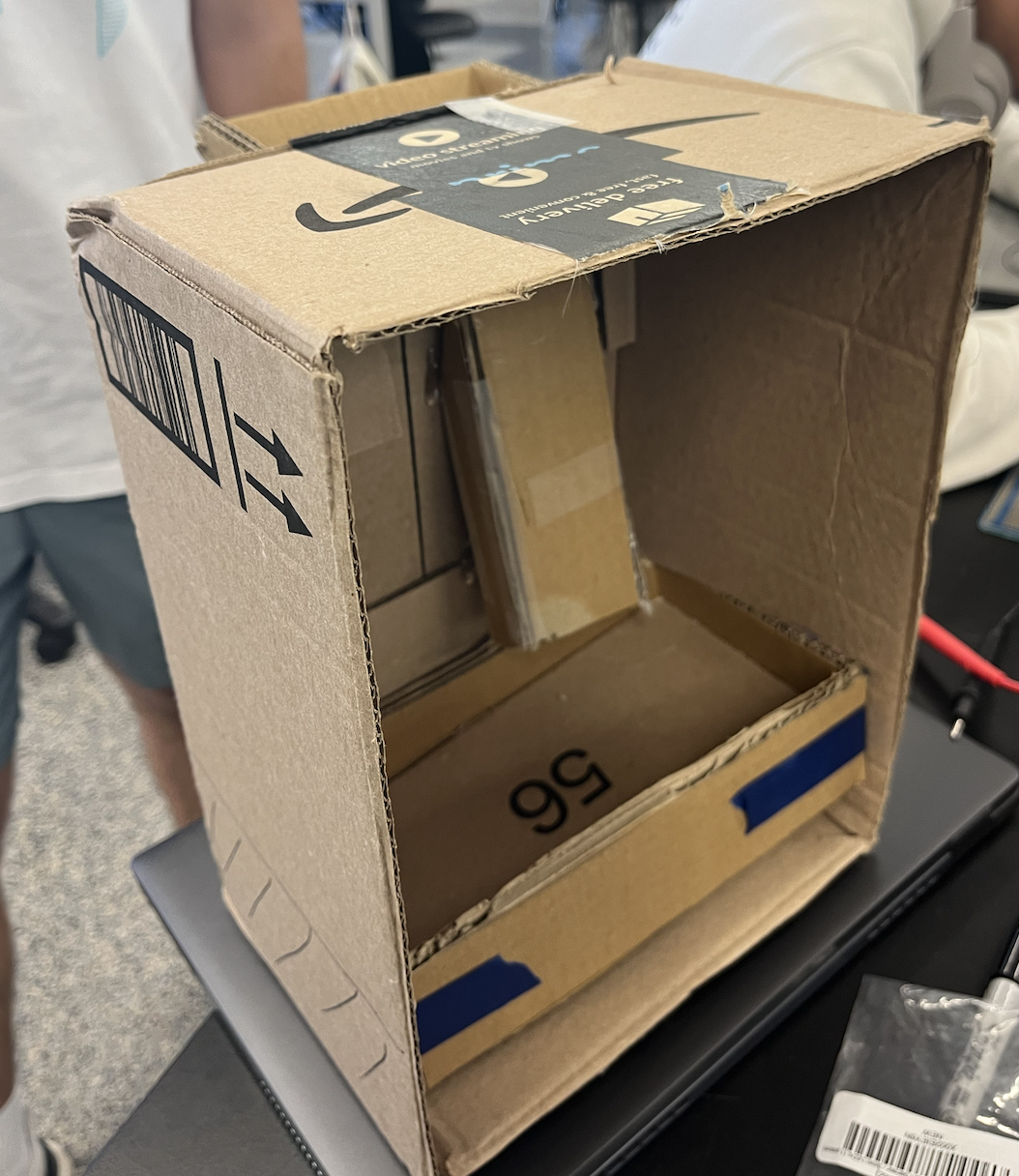
Prototype #1: Low Fidelity
Purpose: Establish proof of concept, determine sizing of components
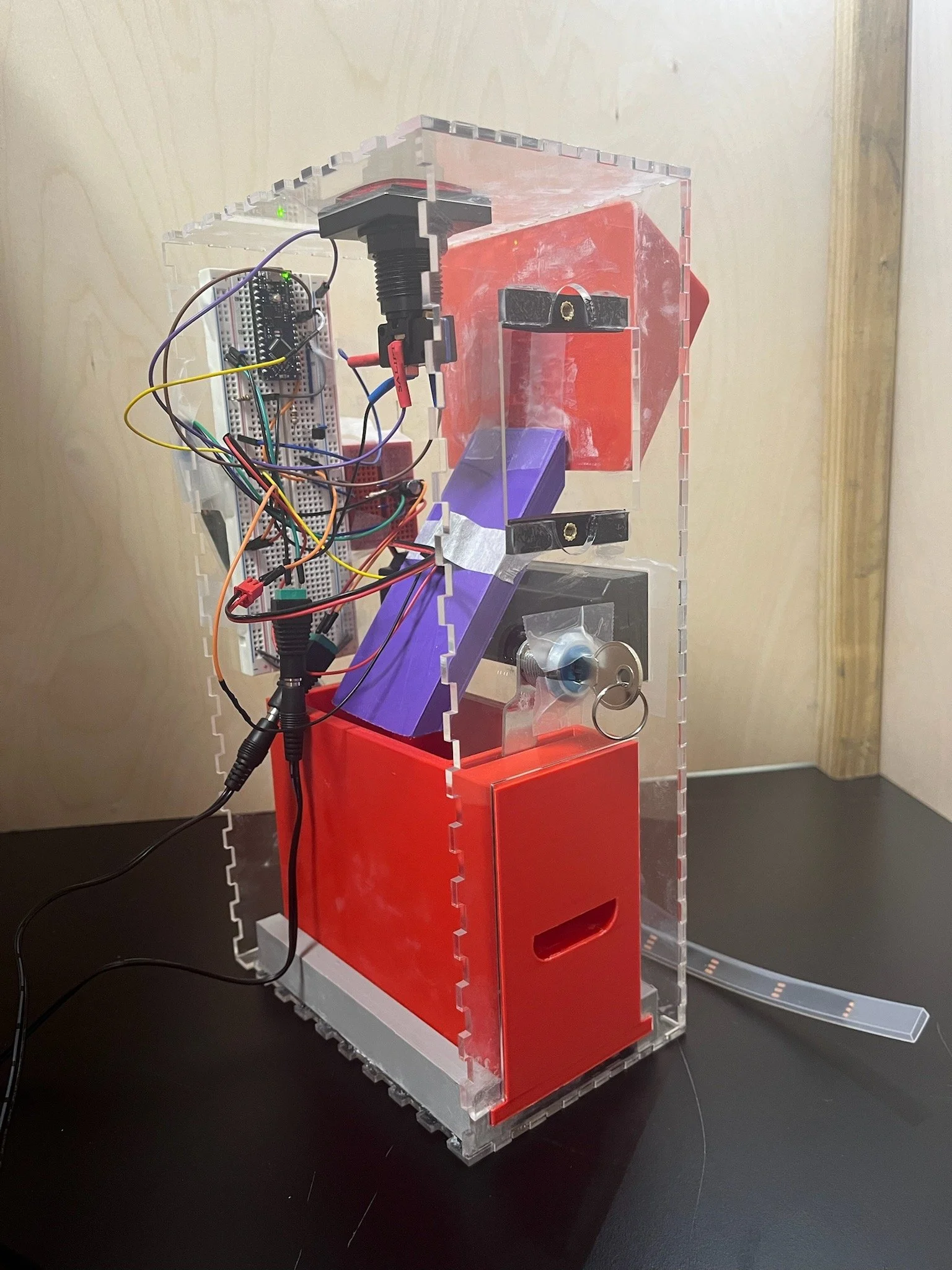
Prototype #3: High Fidelity
Purpose: Test integration of electrical and mechanical components
Personal Contributions
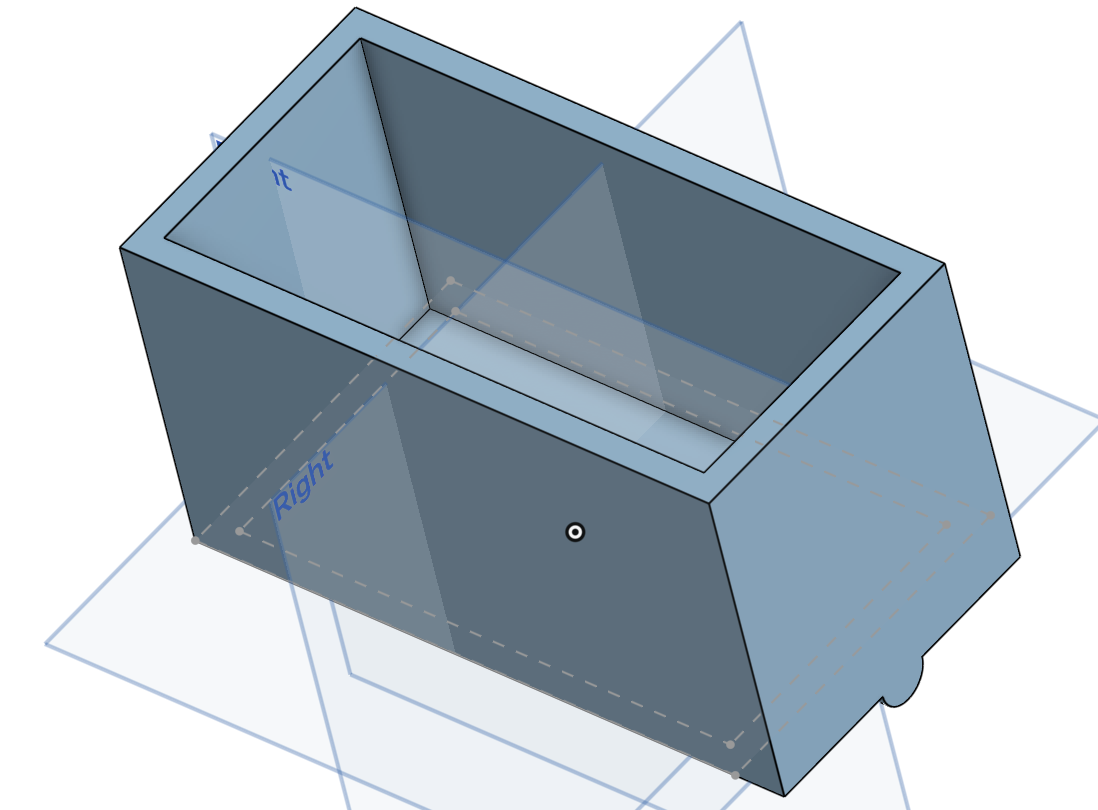
First CAD model
Skills
CAD Modeling (OnShape)
3D Printing
Laser Cutting
Design for Assembly
Rapid Prototyping
Iterative Prototyping
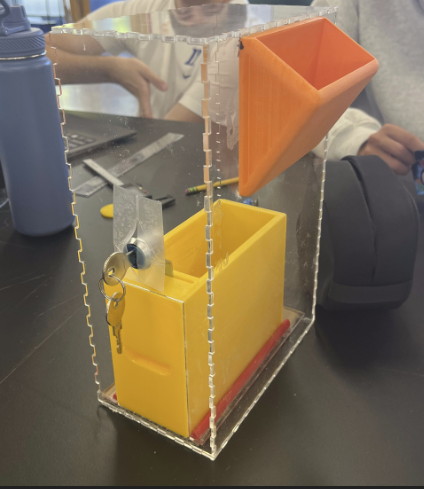
Prototype #2: Medium Fidelity
Purpose: Test integration of acrylic box and 3D printed parts, identify areas for improvement
Final Prototype!
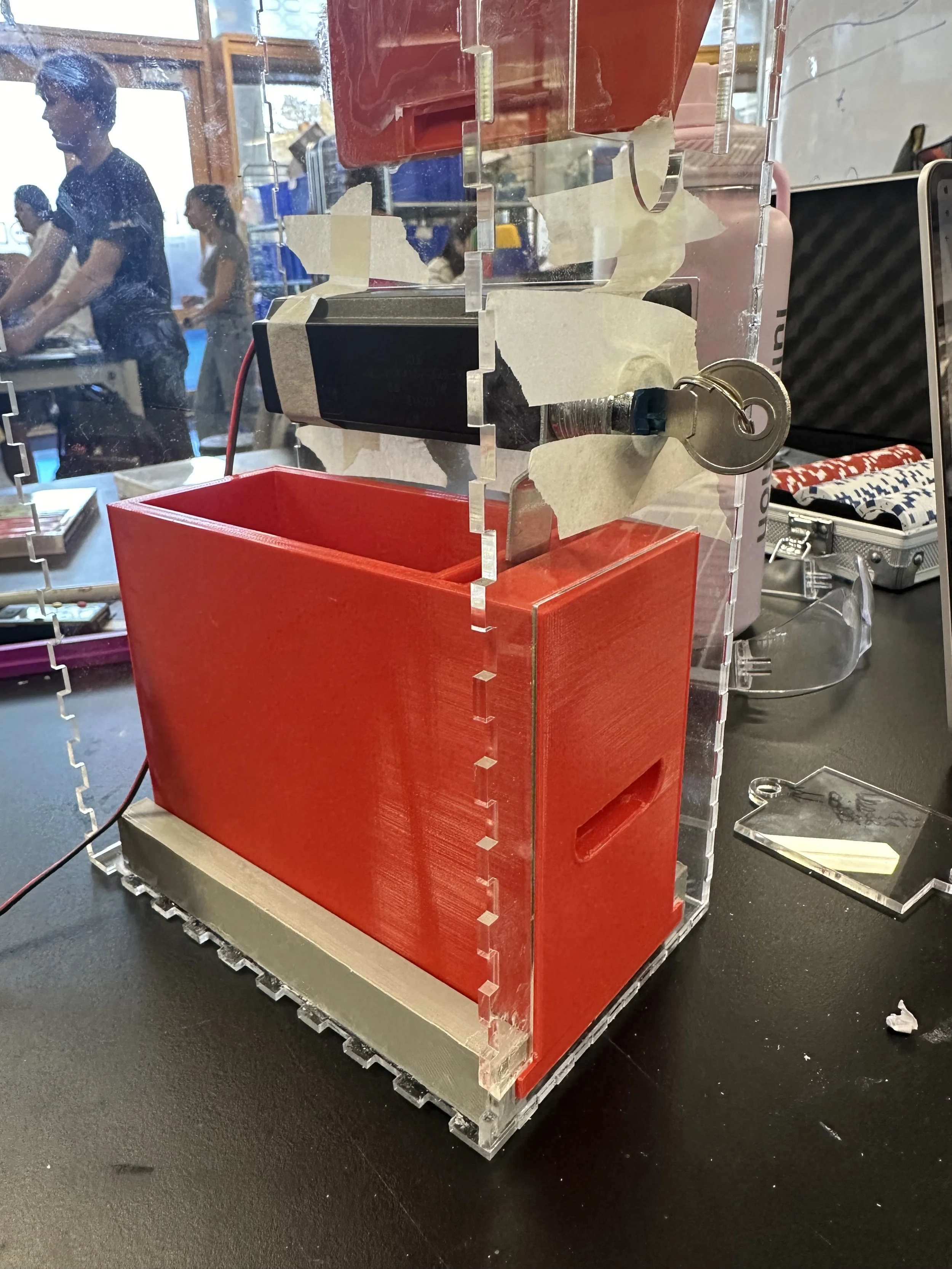
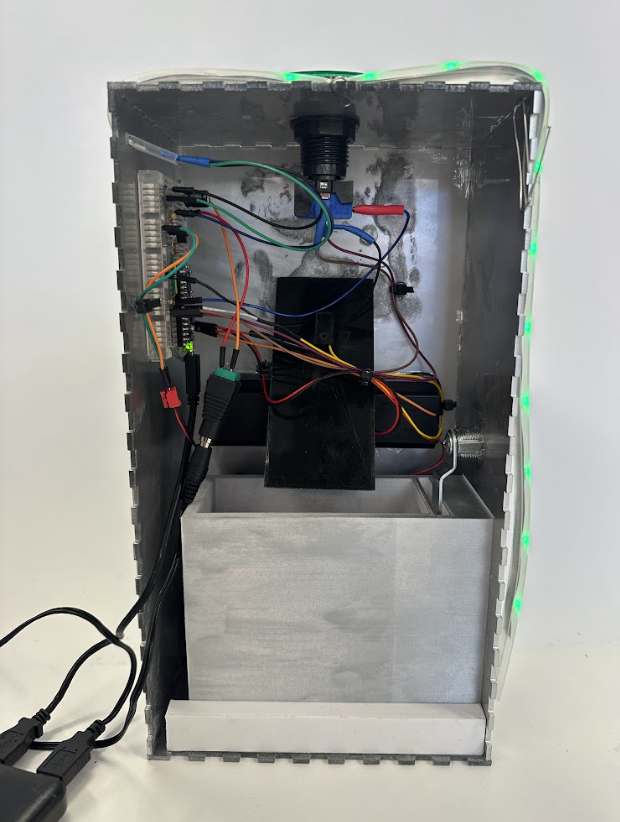
I designed the storage system for the Token Taker, which Kidzu staff identified as needing to hold at least 40 tokens, slide smoothly, be easily accessible for staff, and restrict children from opening it. To do so, I developed a rail-guided drawer system in OnShape. Originally, I did not include the rails, but early testing showed that a barrier was needed to prevent the drawer from moving in the up/down and left/right dimensions. To prevent children from tampering with the Token Taker and attempting to take tokens from the drawer, I designed it with an inset handle and barrel lock, so that it blended into the side of the Token Taker and could only be opened with the staff’s key.
Conclusion
Later iteration with rails and integration with barrel lock and Token Taker housing
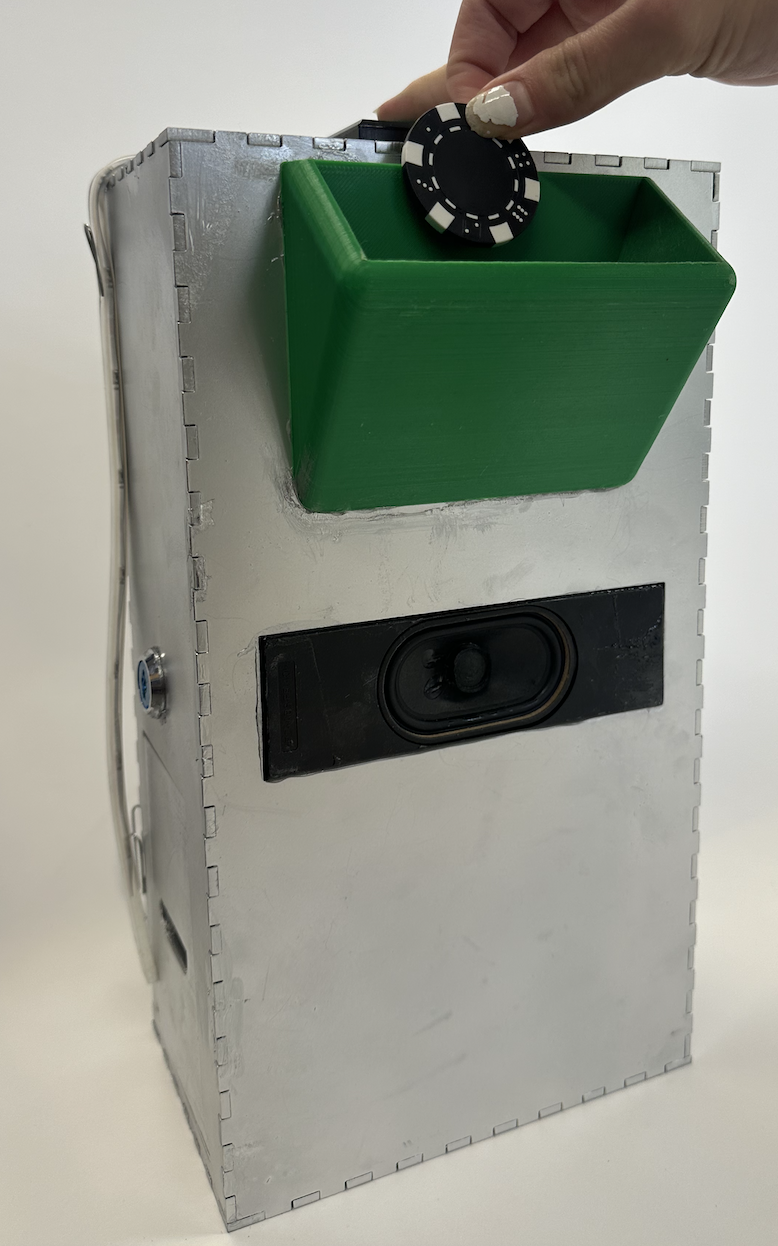
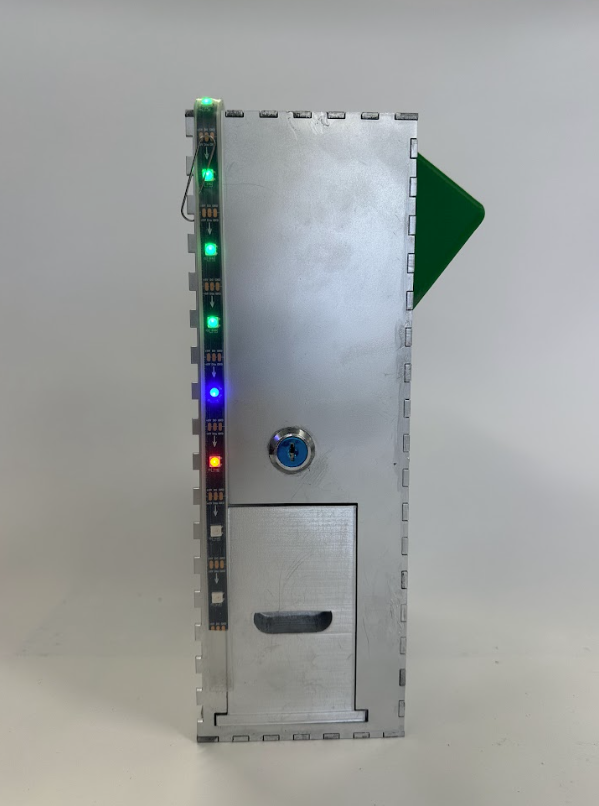
Side view of final storage system
Front view of final storage system
This project marked my first experience with the full product development process, and it was instrumental in shaping how I approach engineering problems. Building the Token Taker taught me how to start with a problem, identify the optimal solution, then effectively create, iterate on, test, and present that solution, all while collaborating with a cross-functional team. The project strengthened both my technical and project management skills, and reinforced how much I enjoy combining technical and creative skills to solve a unique problem, which is the mindset that’s become central to how I approach all of my engineering work.