Rube Goldberg Machine
EGR 121: Engineering Innovation
Objective
Working in a small group, create a “SportBot” machine that demonstrates two different sensor-activated ball-handling and transfer techniques. Your SportBot must be able to twice receive a ball, perform a sensor-triggered action, then transfer the ball to another SportBot in your larger group. Additionally, your SportBot should be as athletic, colorful, creative, dramatic, and entertaining as possible.
Brainstorming
Outcome
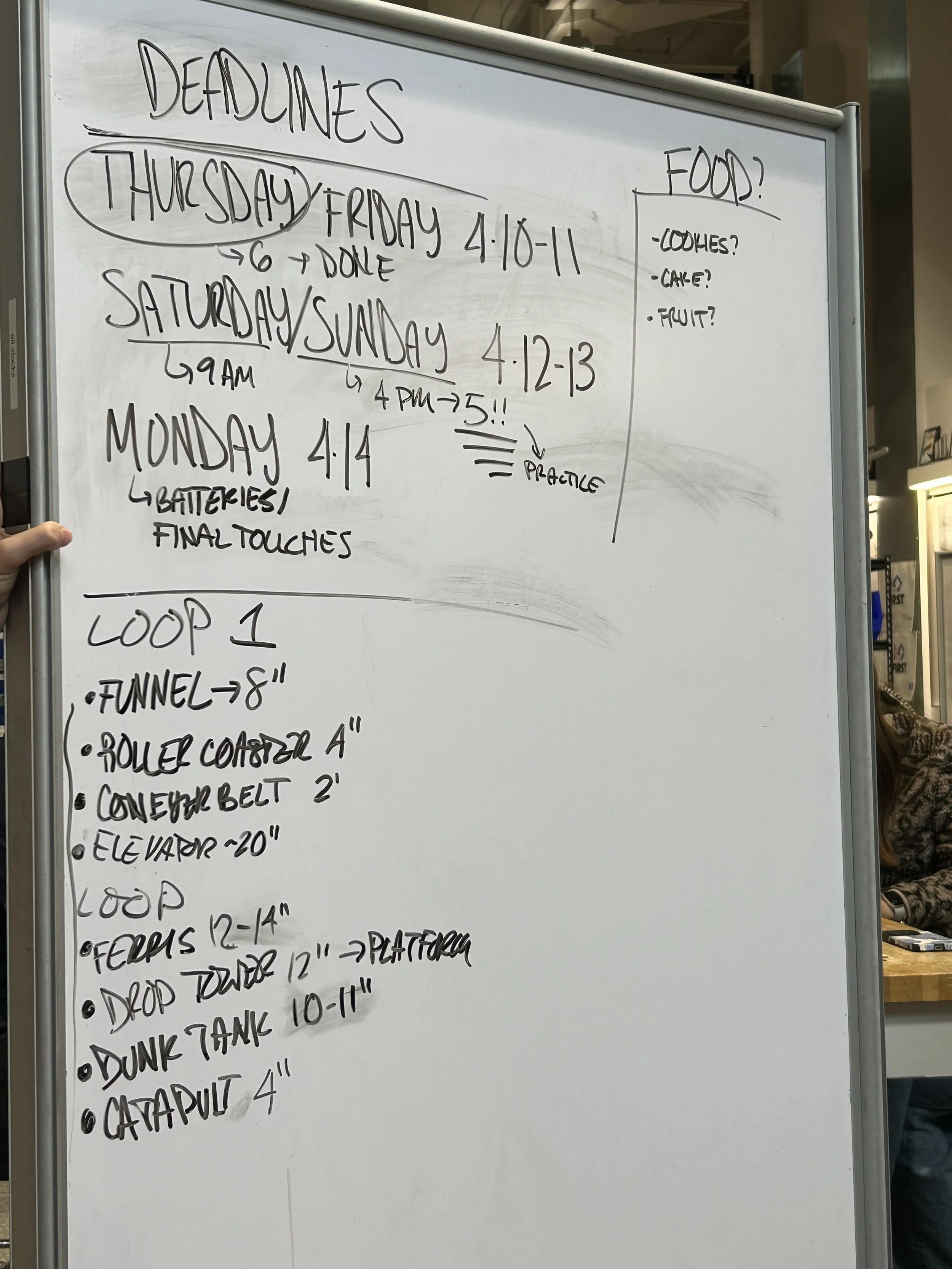
Our large group consisted of 4 smaller groups, each of which was to create their own SportBot. We began the brainstorming process all together, deciding on our theme, individual SportBots, and how the ball would loop through the machine. We also set a series of deadlines, which ended up being critical to our success, as we only had two weeks to build the entire machine.
Then, in my smaller group of 4 people, we determined how we were going to build our SportBot. Our two components were:
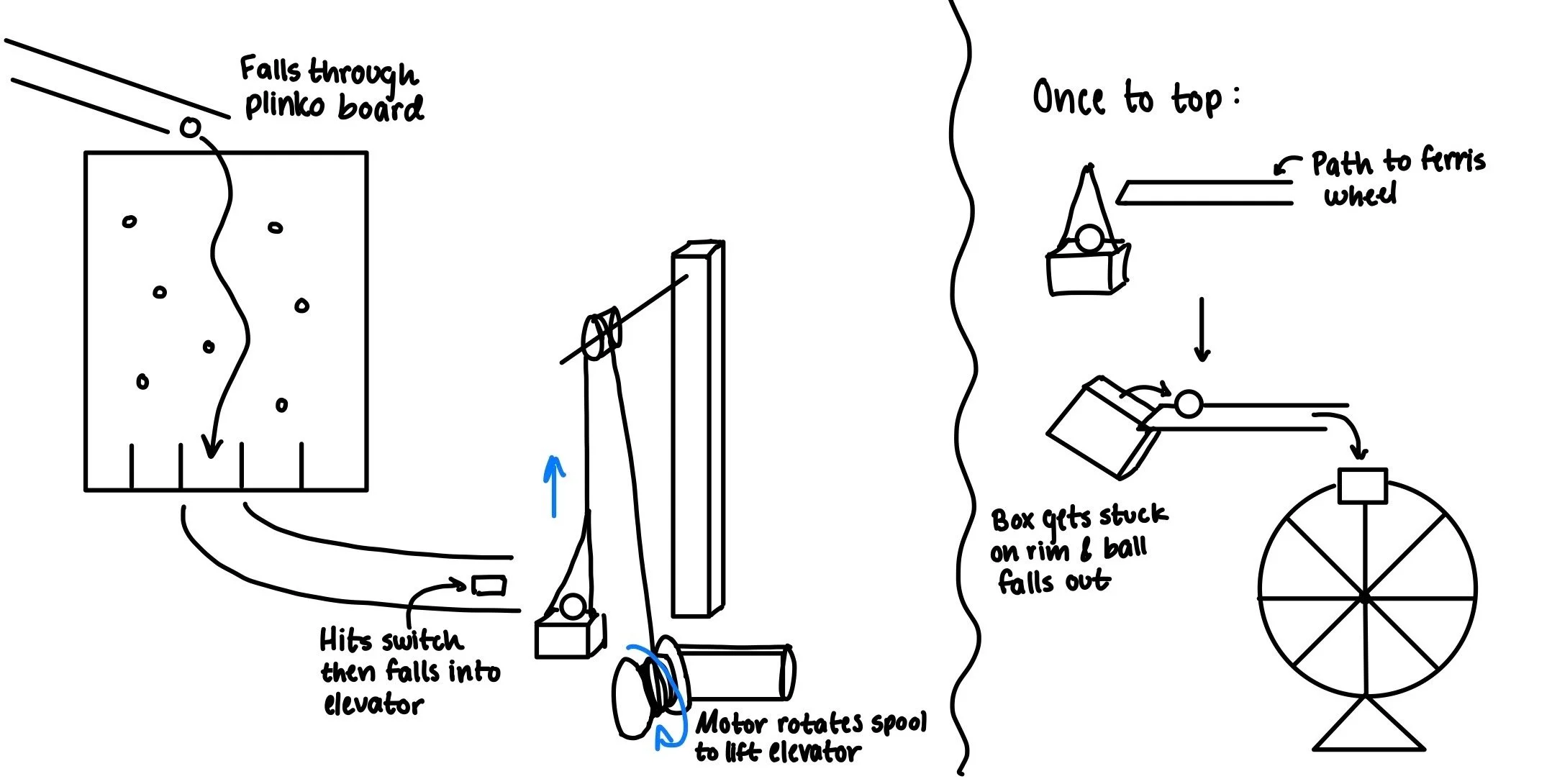
Plinko Board that drops the ball into an elevator, which then lifts the ball up to a path
Catapult that launches the ball into a tower of cans
We broke up into two pairs to accomplish this task, and my partner and I were responsible for building the Plinko Board and elevator. We decided to laser cut the Plinko Board, and power the elevator with an analog circuit that utilized a switch, 555 Timer, and motor.
Circuitry
Our large group of 12 made a carnival-themed Rube Goldberg machine that ran successfully twice during the first 10 minutes of our 25 minute presentation block! My small group’s SportBot, which consisted of an elevator and catapult, ran successfully in nearly 100% of trials.
Skills
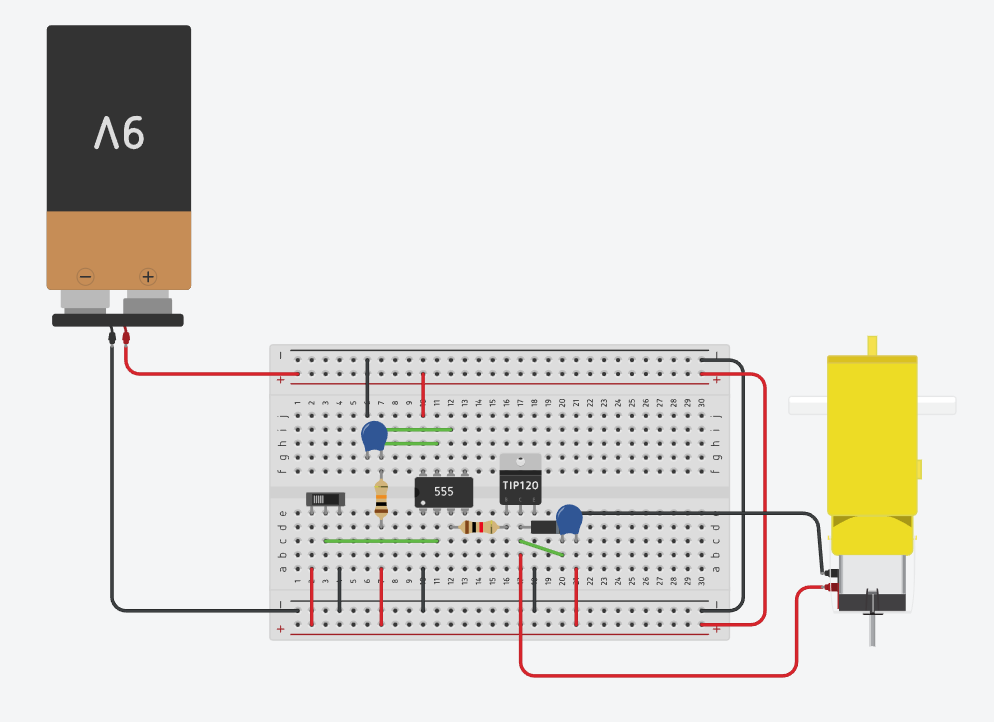
TinkerCad model of our circuit that utilized a 555 Timer to power a motor for 10 seconds
CAD Modeling (SolidWorks)
3D Printing
Laser Cutting
Analog Circuitry
Electromechanical System Design
Teamwork/Communication
Time Management
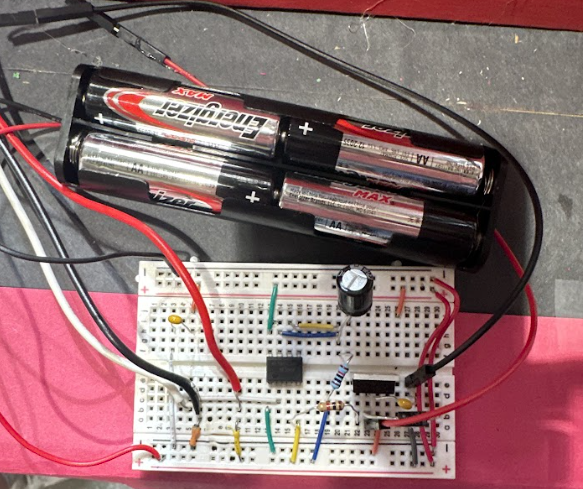
Final circuit used in our SportBot. We had to experiment with the resistance to ensure the motor pulled the elevator the correct distance.
Elevator Design & Lessons Learned
I’ll be the first to admit that designing the elevator was incredibly challenging. My partner and I originally intended on the following design:
Ball lands in circular compartment from Plinko Board → Weight of ball triggers button → Motor lifts elevator compartment → Compartment tips over on ramp → Ball spills out
However, we quickly got stuck in a loop of identifying a problem, solving that problem, and creating another problem in the process. We eventually had to take a step back and consult our teammates, who helped us come up with a completely new design. Our new elevator compartment featured a sloped bottom that allowed the ball to roll onto the ramp without requiring the compartment to flip, which was far more simple and reliable. Although this experience was incredibly frustrating at the time, it taught me valuable lessons, including:
Sometimes it’s more productive to try a new idea rather than spending hours trying to make your original one work.
It’s important to take a step back and re-evaluate your ideas early and often.
Reaching out for help is a valuable problem-solving technique, not a sign of weakness.
Iteration isn’t a linear process. Setbacks are often necessary to reach the best solution.
Early prototyping and testing can expose flaws that aren’t obvious in the initial concept.
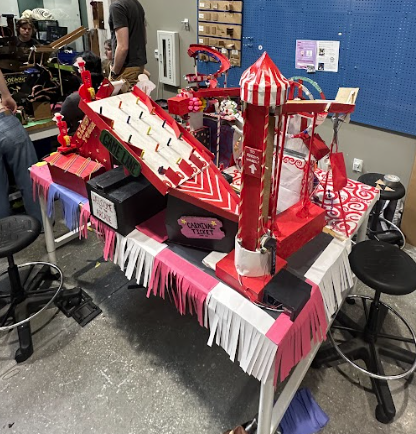
Our final Plinko Board and elevator, which utilized the revised design
Final Rube Goldberg Machine
Overview of the entire machine
Conclusion
The machine successfully running!
As I highlighted above, this project was definitely challenging at times, but it ultimately taught me valuable lessons about successful design, teamwork, and time management. Building a fully functional Rube Goldberg machine in just two weeks initially felt overwhelming, but breaking the project down into smaller, well-defined systems and maintaining clear communication with my teammates made it far more manageable. This project also strengthened my understanding of circuitry and how electrical components can be integrated with mechanical elements to create an efficient electromechanical system. In the end, it was incredibly rewarding to see all of our planning hard work culminate in a colorful, entertaining machine that operated reliably and successfully.